Tuesday was spent on Lake Titicaca. The lake is the world’s highest inland lake at 3800 metres and covers 8400 km sq. It is home to some indigenous tribes who still live in traditional ways.
There are 100 floating islands on the lake. These are made from the reeds which grow throughout the lake and are home to the Immara peoples. These island we visited was home to 8 families and about 28 people. They need to add additional reed layers to their island every 3 months, they live in little reed cottages and build reed boats. They have solar electricity and gas cooking but no heating – at night they just go to bed with girls sleeping with parents until they marry. They are close to mainland so barter fish and bird eggs at the markets for supply but also host a tour group about once a fortnight for their major income.

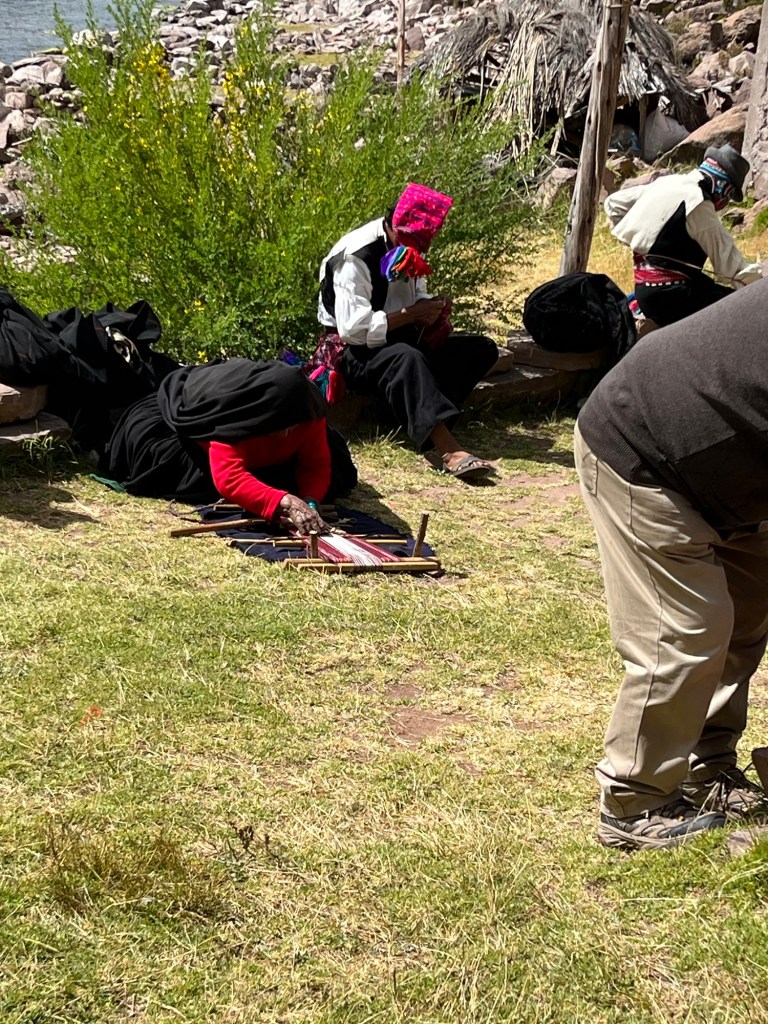
Our second visit was an hour across the lake to a weaver society. These people are based on one of the 35 islands on the lake. Being remote, they have little contact with the mainland. They grow crops for own use and keep some sheep and cows, but their main occupation is weaving for which they are world renowned with pieces featuring in galleries. When they are not otherwise working, the women weave in the traditional way, sitting on the ground and the men knit. The kids start from age 6. The pattern on their knitted caps signify their age and marital status.
They are seriously into coca leaves. When the village headman came to collect our payment he handed each of our hosts a handful of coca leaves ( a traditional greeting) which they immediately started chewing.

 Round about